

7/01/2007
Rhythm and Noise - Naut Humon - Z'EV
Where South San Francisco ends, desolation begins. In November 1980, flyers began appearing on neighborhood telephone poles announcing an upcoming Rhythm & Noise show. "Crisis Data Transfer," the poster promised. No location was given, but a recorded phone message provided detailed directions to "The Compound."
The Compound sits among a grim terrain of decaying housing, abandoned warehouses, electrified chain-link fences and packs of wild dogs. It was R&N's first show. Upon arrival, walkie-talkie-wielding attendants drove our cars away, leaving us to warm our hands at scattered timer fires. The scheduled showtime came and went and still we waited and shivered in the damp Bay air. Finally, a huge steel grate door was raised and we entered into billowing smoke and ten channels of surround-sound. The interior was banked with video screens of all sizes and enough sound equipment with which to construct a small village, most of it with that homemade hacker's look to it. "Vaudeo" they called it: video narratives set to live and manipulated soundscapes. The music screeched, droned, undulated, and even, on occasion, harmonized -- always with some semblance of a beat. Rhythm & Noise -- a well-named ensemble. The Compound is scarier than ever now that crack kings control the territory. The video screens are gone and the cavernous interior is jammed with hanging steel drums, hollow tubes, huge springs, wires -- wires everywhere -- and a baby grand piano. A control tower houses an intimidating array of sound equipment -- analog, digital, sampling, synthesizing, hybridizing, mixing boards, keyboards. A Mac II waits in the wings.
--------------------------------------------------------------------------------------------------
"...In the early '70s Z'EV entered the picture. He was working with all these metal assemblages. He'd tune these racks of scrap until they were welded sculptures with sound functions. I'd quit Cal Arts so I could invest my money in equipment. We formed a group called Cellar M to combine live percussion with electronic manipulation. We did some good work, but dissonance wasn't hip yet." --------------------------------------------------------------------------------------------------
Q: How fully did you work out the pieces you performed with Z'ev?
A: There were definite flight plans, but they had room for spontaneous combustion.
Q: When did Rhythm & Noise emerge as a distinct entity?
A: In 1976, Nik Fault, Rex Probe, and I began a heavy period of research and development. We sold a lot of what we had and began to build most of our equipment. We started to develop The Compound, though we didn't actually perform until 1980. The punk/industrial movement was strong by that time, so we got some recognition, but people still couldn't understand it emotionally. At least not the way they could understand Led Zeppelin or whatever else they were used to listening to.
Q: You hadn't recorded anything yet?
A: Right. That's where Throbbing Gristle had an edge. They had a product. We had always avoided that. It wasn't until 1984 that the Residents convince us to record on their label Ralph Records.
Q: Is it possible to point to any roots for your music?
A: Our roots are more in timbre than in rock 'n' roll. We were definitely aware of people like Stockhausen and Xenakis. I listened to Hendrix, but the thing that was interesting was that he was adding noise to the blues and making it popular. I saw a bridge between Hendrix and Stockhausen. The challenge was to understand noise in an emotional manner.
Q: What distinctions do you make between live and recorded versions of your pieces?
A: Live performance should be different from what you experience in your living room. On the one hand, you have to create links to the past, to what is familiar, but live music should offer a sense of involvement, of immediacy, of surprise. It fascinates me how many rules you can break.
Q: You've talked about the concept of "dissonant convergence."
A: These are not necessarily contrary terms. R&N is realizing-embracing more mass harmonic structure because we are working to understand the harmonic of noise as well as the dissonance. The question is, do dissonant sounds form harmonics or a larger dissonance? You have the effect and the after-effect. Each sound becomes a memory capsule that you place in your own spectrum. It meshes with each subsequent sound. You determine its esthetic. One man's noise is another man's poison. Another question is, do you always need a beat, a rhythm, a pulse to make the relationship with the timbre, to make it speak to you or to the masses? It's hard to break out of pop shells. People don't understand things that aren't part of their existing paradigms. They want to be able to hum it, to remember it from high school days. I like how hip-hop is played through jam boxes so loud that distortion becomes part of the esthetic. In Cairo, the muezzin chants through loudspeakers so tinny and loud that noise becomes part of the prayer. And boom cars -- it's no longer, "My Cadillac is bigger than yours," now it's, "My noise is bigger than yours because I have five woofers." It's an intentional misuse of the technology. It proves that attitude depends on how you listen. You might like the music you hear while inside a club, but it might sound like noise if you live across the alley. We sound like noise to a lot of people."
||||
6/24/2007
Industrial Culture | "True Stories About True Gore", by Jack Sargeant
"Why do we watch a car accident on the freeway, or rush to see a fire, to drink in the tempestuous loveliness of terror, or simply to catch a glimpse of our destiny?" - True Gore
"That's my primary goal. To get on people's nerves. So I always try and have something in them which I'm sure will get on somebody's nerves. And it's not a success unless people...or somebody...walks out, as far as I am concerned" - Monte Cazazza.
Opening with the credit "The Gore Brothers Present..." True Gore (1986) is the logical heir to the mondo movie, that bizarre genre that welds together the freak show, anthropological curiosity, and pure, salacious voyeurism. Directed by Matthew Causey, with Monte Cazazza credited as "creative consultant", the low-budget True Gore is reminiscent of the later, more notorious, mondo movies such as Faces Of Death (Conan Le Cilaire, 1979), and its many sequels. While these now-legendary genre films were produced for box office release most were considered too extreme, even for the sleazoid crowds inhabiting the scummy cinemas of 42nd Street and Times Square, and it was on video that they found their audience, in recognition of this True Gore, like many of the mondo movies of the late eighties, was produced directly on video(1).
Divided into four sections - The World Of The Dead, The Eroticism Of Decay, Art And Death, and The Science Of Death - True Gore feigns an attempt at structural coherence, but the optical effects created using a video synthesizer and designed to mask the identity of the film's unnamed narrator, the purposefully clichéd narration, and the occasionally misspelled subtitles belay its low budget. However, this should not be used as a reason to decry the film, so much as it should be seen as a signifier to other mondo texts, which themselves are in part characterized by their less than pristine appearance, indeed the style adds to the illicit thrills offered by the genre. Like many of the later mondo films, True Gore focuses primarily on images of injury, death and decay(2), however, in addition to those images familiar to the genre, the film also contains many segments culled from Monte Cazazza's own underground filmmaking practice(3).
The first section of the film - The World Of The Dead - consists of re-photographed images culled from medical textbooks and police training manuals, forensic pathology and medical education films, and some original footage shot in a morgue. These grisly images of damaged and rotting flesh are followed with clearly faked footage of a suicide victim laying in a blood filled bathtub, casually slashed wrist dangling over the side of the bath, blood dripping onto the linoleum floor(4). Where this section becomes most disturbing is in its usage of the aural footage of Jim Jones' last speech as 956 members of the People's Temple commit suicide slurping cyanide contaminated fruit juice. The suicide soundtrack - dubbed over photographs depicting various iconographic elements of the People's Temple, including their discipline room - was culled from Cazazza's extensive archive, and was also released as a picture disc by the World Satanic Network Service(5).
As the film's second section starts the narrator states, with a showman's faux cynicism, "in the underground of the world these films are created for the sickest minds". This is followed by a collage of shots taken from the legendary First Transmission video, produced by the Temple Of Psychic Youth(6), and depicting scenes of ritualized SM sexual experimentation. These images are familiar to anybody who witnessed Psychic TV in their pre-acid house daze. Cazazza was, of course, a regular collaborator with P. Orridge and Psychic TV. The accompanying extra-diagetic soundtrack consists of Cazazza's "Sex Is No Emergency". This segment also contains images - "from Amnesty International" the narrator states - depicting a man being suspended over an oil-drum filled with water, before being dunked and beaten. For added effect a snake is thrown over the drowning man's head. The footage is fake. The victim is Cazazza. This scenes is followed by some genuinely disturbing images of vivisection: a live pig is tied down and military scientists stand over it holding a blow-torch, which is then played slowly across the squealing animals flesh which rapidly blackens, burns, and splits open. Next a cat has its scalp pealed and a chunk of its brain removed, as the narrator observes such experiments appear as senseless exercises. These images of genuine cruelty appear all the more horrific because of their juxtaposition with the fake footage.
True Gore's third section, Art And Death, focuses once more on Cazazza's underground movies, as the narrator wryly comments, "at least it was self inflicted" the sequence is culled from Cazazza's 13 minute Super 8 collaboration with Tana Emmolo Smith, SXXX-80 (1980), a film which gleefully depicts what many would consider polymorphic sexual dysfunction as home movie, and was produced as a result of equal parts ennui and mischief on Cazazza's part. The extract presented in True Gore depicts Cazazza digging at a sore on his penis with a metal scalpel, and Smith letting a gigantic black centipede scuttle over her labia. Mimicking the fake-decorum of the death film genre, Smith's vagina and Cazazza's penis, both of which are visible in the original short film, are hidden behind tastefully positioned black squares, this is after all not a sex film(7).
The extract from SXXX-80 is followed by a sequence taken from the 40 minute video Night Of The Succubus (1981) which documents a chaotic performance between Cazazza, Survival Research Laboratories and San Francisco Industrial band Factrix. From this ostensibly performance art documentation the film returns to the theme of necrophilia and lustmord. The ensuing footage, supposedly depicting two psychotic paraphyliacs, is faked, with a female necrophile played by artist Debra Valentine, and a male murder played by Cole Palme, who, despite being in shade, should be familiar to the film's audience, having just appeared in the previous scene playing bass and singing with Factrix. The performances given by these actors are convincing primarily because the scenes were shot in one take, with the actors reading from a script, the occasional stumbled words and phrases serve to create a haunting, confessional atmosphere.
The film introduces the thematic of AIDS as the latest plague threatening to annihilate humanity. Notably, given the media treatment of the virus as "gay" and "junkie plague" at the time of True Gore's production, the film draws attention to the fact that AIDS is a disease that can attack anyone "we are all victims", drawls the narrator. Genuine autopsy footage ends the section of the film.
The Science Of Death - True Gore's final section - consists primarily of stock footage depicting the shivering survivors of the Nazi Death Camps, which is intercut with images from Leni Riefenstahl's Triumph Of The Will (19 ). This is followed by what the narrator describes as "our homage to the Scientific Age". To the Atom Smashers' song "A Is For Atom" the film juxtaposes images from Cold War propaganda films with scientific cartoons explaining radiation, and images of the burned and mutilated survivors of Nagasaki and Hiroshima.
The film closes with the narrator walking through a graveyard, and telling the audience "to live in fear of death is a waste of life". A short, sombre scene follows, depicting row-upon row of tombstones. The soundtrack consists of church bells. The camera spins through the graveyard and positions the viewer gazing out from an open grave. This cuts to the image of a laughing mechanical clown, once more suggesting the carney roots of the mondo genre, and the wound black humour of True Gore's aesthetic. End.
Notes:
(1)Other direct to video mondo film's include Nick Bougas' excellent Death Scenes (1989) and Death Scenes 2 (1992), and the Brain Damage production Traces Of Death (1993).
(2)Earlier mondo movies - produced in the sixties - whilst presenting some violent images, also luxuriated in scenes of indigenous cultures (and especially those cultures for whom nudity is a norm), nudist colonies, occult ceremonies, and safari scenes, all of which have subsequently became visual staples on television. The genre's interest in sex and sexuality boomed in the early seventies, with titles such as Alex De Rezny's Sexual Encounter Group (1970), Sex And Astrology (1970), and Sexual Freedom In Denmark (1970), as well as Pat Rocco's Sex And The Single Gay (1970), but was rapidly rendered as pointless with the explosion and subsequent availability hardcore pornography in the seventies (following the massive success of Gerard Damiano's Deep Throat which - in 1972 - served to partially legitimize hardcore, and also served to show the massive market for such movies). Finally it was the continued taboos surrounding violence and death that remained, and these have subsequently become the focal point of mondo movies. This thematic eruption is also due to the increasing availability of footage depicting violence and death, due - primarily - to the popularity of video technologies which are utilized by news gathering teams, as well as the emergency services, thus guaranteeing a virtual glut of available visceral footage.
(3)Cazazza has directed, produced, and collaborated on a string of movies, including, amongst others: Revolt 2000 (1974) in which he acts like a terrorist and builds a bomb using information from Assassin magazine, the film is now lost. Diary Of A Rubber Slave (1976) subsequently stolen, Mondo Homo (1976) - another engagement with the mondo genre, filmed in secret at the notorious gay bar The Slot, the film was one of the first to depict fist fucking - subsequently stolen. Mystery Movie (co-directed with Genesis P. Orridge, 1976, whereabouts unknown). Death Wish (1977), consisting of re-photographed tv footage. Black Cat Tea (co-directed with Mary Quayzar, 1979/80), Behind The Iron Curtain (1980), SXXX-80 (co-directed with Tana Emmolo Smith, 1980), Night Of The Succubus (co-directed with Factrix, 1981), and Catsac (with Michelle Handelman, 1989) . In addition Cazazza has produced and collaborated with Handelman on Blood Sisters (1991), and collaborated with Psychic TV on the videos Terminus and Eden Three (1987).
(4)The usage of re-constructed / fake footage is one of the central aspects of the mondo genre in its latter incarnation as a grim sideshow of annihilation.: "Although many of the sequences involving killings were fabricated, the filmmakers attempted to make distinguishing fake from fact as difficult as possible" (David Kerekes and David Slater, Killing For Culture, An Illustrated History Of Death Film From Mondo To Snuff, Creation Books, 1995 (first published 1994) p.113).
(5)The World Satanic Network Service aka Vagina Dentata Organ released a string of records documenting various extreme events, including Cold Meat, which consisted of the sound of somebody breathing - and dying - whilst on an infribulator, and came as a picture disc depicting photographs of Maralyn Monroe and Elvis Presley in death.
(6)This video depicted various rituals undertaken by members of the Temple Of Psychic Youth, and was frequently screened, in both whole and part, during the early eighties. In 19 however a copy fell into the hands of a right-wing fundamentalist group, who used the tape to `prove' Satanic abuse.
(7)It is an oddity of the mondo genre that, whilst depicting death with glee, depictions of sexual organs are less common, with producers and directors frequently choosing to hide them behind visual effects, this reaches its zenith in Death Women - a Japanese film of unspecified date and direction - which depicts extreme images of female corpses - strangled, crushed, torn, ripped, savaged, and burned - yet tastefully pixellates any images of the corpses' pubic region and vaginas.
©Jack Sargeant
6/19/2007
Minimal Man [MP3s + Webpage]
Check out the tribute page I made for MINIMAL MAN (aka PATRICK MILLER) on mySpace, which currently has 4 tracks up for listening (not downloadable):
*I will also be posting 1 or 2 Minimal Man mp3's sometime soon, on this blog...any requests?
- She Was A Visitor
- Ascension
- Show Time
- High Why
*I will also be posting 1 or 2 Minimal Man mp3's sometime soon, on this blog...any requests?

3/13/2007
Iannis Xenakis: Phillips Pavilion, Poème Electronique, Edgard Varèse [Brussels 1958]
 The Philips Pavilion was more than a building at the fair -- it was a multimedia experience displaying the technological prowess of the Philips company by combining light, sound, and color.
 Le Corbusier's involvement in the Philips Pavilion is often overestimated. In reality, most of the designing was carried out by his collaborator Iannis Xenakis (b.1922) a Greek architect and music composer working in Le Corbusier's office at the time.

These photographs taken from a 1958 issue of Philips Technical Review depict the Philips Pavilion at the 1958 Brussels World's Fair. Located in a small site next to the Dutch section and away from the center of the fair, the pavilion hosted a futuristic multimedia display featuring images, colored lighting and music and sounds called the "Poème Electronique."
Some of the greatest artistic minds of the twentieth century were involved in its creation, including the architect Le Corbusier (1887-1965) and the composer Edgard Varèse (1883-1965). But most importantly, the Philips Pavilion represented an important artistic phenomenon through its synthesis of architecture, visual media and music.
The purpose of the pavilion was to exhibit the technology of the Philips corporation, a Dutch electronics company specializing in everything from sound production to fluorescent lighting to X-ray technology. Philips' aim was obviously promotional, integrating corporate advertisement into an exhibit much like the pavilions by General Motors and Ford at the Chicago fair of 1933 and the New York fair of 1939. But rather than having a traditional pavilion that would display their products for the visitors to browse through, Philips chose to create an integrated work of modern art that would utilize its wide array of technologies. Therefore, the Philips pavilion had no exhibits per se; rather it was a kind of exhibit in itself; an all-encompassing showcase of what the Philips corporation could offer.
For the execution of this unique undertaking, Philips selected the French architect Le Corbusier, one of the greatest modern designers of the twentieth century. Philips executives approached him in January 1956 to design, in the words of artistic director Louis Kalff, a "spatial-color-light-music production" for the Philips corporation (Treib 2). Le Corbusier was by this time near the end of his career, but also at the height of his powers, as demonstrated by his recently completed masterpieces including the Unit‚ d'Habitation in Marseilles (1946-52) and the chapel of Notre Dame du Haut in Ronchamp, France (1950-54). Philips executives no doubt expected a first-class design from Le Corbusier, but they also expected him to direct the entire concept of the Poème Electronique and all of its images and lighting, in addition to the architecture. In effect, Philips gave Le Corbusier carte blanche to create their pavilion, insisting only that he utilize the various technological media the company was producing.
Le Corbusier's involvement in the Philips Pavilion is often overestimated. In reality, most of the designing was carried out by his collaborator Iannis Xenakis (b.1922), a Greek architect and music composer working in Le Corbusier's office at the time. Xenakis would later become famous for his use of rigorous mathematical concepts and relationships in his music, but at this time was not well known. This may be part of the reason that he receives less recognition for the design than he probably deserves, coupled with Le Corbusier's prestige and public exaggerations of his own role. Le Corbusier was more concerned with what was going on inside the pavilion and cared little about its exterior appearance. Even the spectacle inside was not completely his own, for the music was by Edgard Varèse, a well-known composer at the time and a pioneer in the field of electronic music and the use of non-instrumental sounds, exemplified by Ionization (1930-31) and Deserts (1949-54). It was Le Corbusier, however, who insisted that Varèse be chosen to compose the music, for Philips wanted to enlist the talents of the more famous but less radical British composer Benjamin Britten. But after succeeding in his plea, Le Corbusier left Varèse a completely free hand in composing the music.
Although Xenakis was the principal designer of the Philips Pavilion, the architecture didoriginate with Le Corbusier's general concepts. These consisted of descriptions of a "stomach" to contain the Poème Electronique, with a twisted path for entrance and exit and warped, curving walls on which to project the colors and images. This basic concept was about as far as Le Corbusier's architectural involvement went. The shape of the building would be left for Xenakis to determine. The pavilion was to serve as a small auditorium, where approximately five hundred seated visitors could see the images projected on all the walls around them, as if it were an irregularly shaped planetarium. His point of departure for the structure was a series of conjoined hyperbolic parabaloids-curved planes mathematically generated entirely from straight lines-that would form a tent-like enclosure for the stomach-shaped floor plan. The sloping walls of the hyperbolic parabaloids would satisfy Le Corbusier's idea of irregular warped surfaces for the projection of images. The geometric form also appealed to Le Corbusier's desire for mathematical rationality while the dramatic slopes and contours of the pavilion related to a more expressionistic idiom.
The execution of the design proved to be problematic. Xenakis' own structural solution involved a tensile structure of steel cables strung from steel posts at the ends of the "tent" to form the hyperbolic parabaloids. It was rejected on the grounds that the interior would require more solid, acoustically insulating walls. Le Corbusier and the sound engineers wanted a structure of concrete to keep exterior noise from interfering with the presentation. But the complex shapes of Xenakis' hyperbolic parabaloids made it impossible to build a conventional poured concrete structure. The solution that would satisfy both Xenakis' ideas and the acoustical requirements of the Poeme Electronique was a system of precast concrete panels hung in tension from wire cables. Because hyperbolic parabaloids are generated by straight lines, the method of using precast panels was easy to implement. This ingenious compromise was devised by Hoyte Duyster, the chief engineer for the Philips project. The panels were constructed in a hangar shed from a simple sand mold that matched the curvature of the pavilion. Once the panels were cast around the sand mold, they were numbered, shipped to the construction site and quickly assembled. They would hang on steel cables strung from thin concrete ribs that were cast in place. These ribs are visible in the photograph where the walls converge at the ends of the pavilion. The result was a quickly and efficiently constructed building that fulfilled the requirements of the Poème Electronique.
While the design of the pavilion was underway, Le Corbusier was busy figuring out what would be happening inside. Le Corbusier wanted the Poème Electronique to consist of an eight-minute film made up of an array of still photographs highlighted by changing washes of colored light on the interior surfaces of the pavilion. The underlying concept related to Le Corbusier's own view of the progress of humankind through history and into the future. However, the Poème would not be a presentation of concrete images associated with events or historical developments. It was meant to be abstract and highly symbolic, with groups of stills chosen to make a statement about humanity. These images, including such diverse subject matter as tribal art, baby faces, animals, machinery, Charlie Chaplin and even a mushroom cloud, were arranged in rather confusing combinations and juxtapositions. For example, Charlie Chaplin and the mushroom cloud would be shown next to each other in an attempt to show the absurdity of modern warfare. The eight minutes was made up of seven sequences: "Genesis," "Matter and Spirit," "From Darkness to Dawn," "Manmade Gods," "How Time Molds Civilization," "Harmony," and "To All Mankind." The actual filming of the images was carried out by Philippe Agostini, a celebrated filmmaker who further enhanced the visual potency of the PoŠme with his techniques of quick montage, innovative framing methods, and rotation, reflection and movement of the images. The color projections were integrated into this grand scheme and were laid out in a sequence that would help dictate the mood of each image or series of images. All visual media utilized Philips' latest projection equipment. The final result was a highly original visual arts spectacular showcasing Philips technology, but more importantly an artistic expression of Le Corbusier's vision of humanity, laced with all its propaganda and personal biases (including images of Le Corbusier's designs meant to suggest mankind's hope for the future).
The audio component of the Poème Electronique however, was completely devoid of the influence of Le Corbusier. Varèse was given free reign in this respect, composing the music sporadically from the time he accepted the commission in 1956 to when it was recorded in late 1957, while the pavilion itself was nearly complete. The music was purposefully to have no relationship to the visual components of the presentation, so that the entire ensemble would not be one of coherence, but one of abstraction and juxtaposition. The eight-minute composition consists of a combination of electronically generated sounds and "concrete" sounds, or real-life sounds and noises that have been recorded. While to most ears the "music" sounds like a lot of swirling and tapping noises with bizarre human voice sounds, it is actually a carefully structured composition with a recurrence of themes leading to variations and climaxes. But the music also had a spatial dimension, in that different sound sequences were directed out of one of the hundreds of speakers that were mounted on the pavilion walls. The effect was a sense of "moving music," where sounds would whisk across the space in a manner that would enhance the rising and falling aspects of the composition itself. The music was the final dimension in this showcase of Philips' technology, for it was all recorded using the company's high-tech audio equipment, and projected from their sound reproduction equipment and speakers. And although it had no direct relationship with the rest of the Poème Electronique, Varèse's music was integral to the final ensemble because it presented a audio component that was as equally modern and abstract as the architecture and images.
The combination of Xenakis' architecture, Le Corbusier's visual ensemble, and Varèse's music provided a very memorable experience. Millions of people visited the Poème Electronique, and all agreed that was new and different. The general public was for the most part baffled by the bizarre images and sounds. Howard Taubman of the New York Times called it "the strangest building at the fair," and remarked that "the sounds that accompany these images are as bizarre as the building" (17). This attitude is generally representative of the public response to the building. The response of critics specializing in art and architecture, however, was extremely varied. A Swedish critic characterized the pavilion as "a deeply fascinating realization of a dream which has tempted artists since...Wagner: the dream of the total work of art" (Romare 175). Although this view is typical of the pavilion's supporters, its detractors often focused on specifics rather than the ensemble in its entirety. The architecture in particular was harshly criticized for its awkwardness and uncomfortable ambiguity between structural rationality and free-form expressiveness. Italian architect Ernesto Rogers thought that "where the result should have been a fluid sequence of convexities and concavities..., there are disturbing elements for reinforcing....It is not a fulfilled architecture, it is not a clear composition; it is only the indication of new architectonic dimensions" (4). Rigid tectonics and smooth, curving surfaces tended to cancel each other out. Varèse's score would exercise the most lasting influence of any aspect of the Philips Pavilion. While not enthusiastically received by the public, it influenced an entire generation of avant-garde composers with its use of electronic music, including the American John Cage and the German Karlheinz Stockhausen. In the end, the area afforded least attention and recognition by the Philips corporation became the most memorable part of their exhibit. The Philips Pavilion is mentioned only briefly when discussing the career of Le Corbusier, as a footnote to an already distinguished career. But the Poème Electronique by Edgard Varèse was one of his greatest accomplishments.
The Philips Pavilion was demolished on January 30, 1959. Like most world's fair buildings, it was a temporary structure never meant to remain standing beyond the duration of the fair. But because it was demolished, the work of art is lost forever. We can see pictures like these, look at Le Corbusier's images, even listen to Varèse's score, but the complete ensemble integrated into a single space surrounding and moving around the visitor is something that can never be recreated. Therefore, the Philips Pavilion and its Poème Electronique remain an artistic achievement that have left their mark on precisely eight minutes of history.
~Aaron Zephir
1/13/2007
VIDEO: Poeme Electronique (Edgar Varese)
REQUIRED VIEWING: "Poeme Electronique", by Electronic Music pioneer Edgar Varese & Le Corbusier. (Originally presented in 1958 at the World Expo in Belgium)
10/30/2006
Industrial Culture Handbook: Monte Cazazza (RE/Search #6/7)
MONTE CAZAZZA
[PARTIAL BIO, 1972-'82]:
In 1977 Monte entered the studios of Industrial Records to record 'Plastic Surgery,' 'Busted Kneecaps,' 'Fistfuckers of America', 'Hate', and 'To Mom on Mother's Day.' His first 45 is out of print. A film was made with Throbbing Gristle where Monte and a 14-year-old were electrocuted. He plays also in the film "Decadence" by Kerry Colonna with razor blades.
[DISCOGRAPHY]:
- TO MOM ON MOTHER'S DAY (45, Industrial Records, IR 005, 1979)
- SOMETHING FOR NOBODY (EP, Industrial Records, IR 0010, 1980)
- MONTE CAZAZZA LIVE (C60 cassette, Industrial Records, IRC 28, 1980)
- CALIFORNIA BABYLON (LP, in collaboration with FACTRIX; Subterranean Records, Sub 26, 1982)
- STAIRWAY TO HELL (SS 45-007, special package with 45, from Sordide Sentimental, France; 1982)
MONTE'S VIDEOTAPES
- Videotape of performances at the SCALA CINEMA and Live at OUNDLE SCHOOL
- NIGHT OF THE SUCCUBUS (produced in collaboration with Factrix, 1981)
PERFORMANCE ART EVENTS
- Large display titled "Defend Yourself" featured board with knives stuck in it (free for the taking). Mannikins dressed as winos and bag people left in alleys with hidden cheap cassette recorders playing tape loops of screams and ranting and raving. Spring 1972. Oakland, CA USA.
- FUTURIST SINTESI. Galeria 591. Sex-religious show; giant statue of Jesus got chain sawed and gang-raped into oblivion. Dec. 21, 1975. San Francisco, CA, USA.
- RADIO AD TV ASSEMBLAGE AND DANCE. Shattuck Ave Studios. Giant wall construction of televisions and radios playing for 3 days (& nights) straight. June 25, 1976. Berkeley, CA, USA.
- MANIC MOVEMENT. Collaboration with Kimberly Rae. Berkeley Square. Kim tied up on spring-mounted platform; Monte appears squirming on floor in black body bag, cuts self out, cuts Kim loose, then destroys toys and props with hatchet to loud Romper Room record. Ended in fire. Jan 30, 1981. Berkeley CA USA.
CONCERTS/MUSIC
- KEZAR PAVILION Performance spectacular with Mark Pauline and Factrix. First time working with Mark. War machines; spinning swastika with Monte inside; Scott & Beth B. films; also showing of "Behind The Iron Curtain" by Monte. Dec 6, 1980. San Francisco, CA USA.
- BERKELEY SQUARE. Guest appearance with Factrix. All music, more sedate show. Dec. 12, 1980. Berkeley, CA
- ED MOCK DANCE STUDIO. "Night of the Succubus" in collaboration with Factrix. Films, slides, organic robots, dance by Kimberly Rae, dart gun used for the first time by Monte, electro-shock, dental surgery on dead animal-machine. Member of audience angrily attacked 'robot' with chair, shouting that it wasn't 'erotic'. Video available. June 6, 1981. San Francisco. CA USA. p. 80
8/11/2006
MINIMAL MAN

Patrick Miller, avant-garde leader of underground 'antimusic' ensemble Minimal Man, was born in Glendale, California, on 2 January 1952 and studied art at Sonoma State University, where he concentrated chiefly on silk-screening.
After moving to San Francisco in 1979 he immediately began to experiment with music and film. Minimal Man began as a vehicle to produce soundtracks for these films, with the realization that anyone could do so given access to the tools. Miller also began to collaborate with a wide variety of punk, new wave and industrial musicians, including Tuxedomoon, and by October Minimal Man were performing at the legendary Deaf Club venue, and elsewhere.
After moving to San Francisco in 1979 he immediately began to experiment with music and film. Minimal Man began as a vehicle to produce soundtracks for these films, with the realization that anyone could do so given access to the tools. Miller also began to collaborate with a wide variety of punk, new wave and industrial musicians, including Tuxedomoon, and by October Minimal Man were performing at the legendary Deaf Club venue, and elsewhere.
Minimal Man became one of a select handful of influential groups from this era to bridge punk and industrial music with aggressive blasts of noise and electronic effects. As the core of Minimal Man, Miller sang (and screamed), played keyboards and manipulated tapes to create their dissonant, unsettling, experimental sound. One critic described the result simply as 'antimusic.'
The band name was inspired by people who lived in the low income Fillmore district of San Francisco. Though often without basic needs, these were people creative in adapting to life on the street. Miller's conception of Minimal Man was a character with 'everything against him.'
The debut Minimal Man album The Shroud Of was originally released by Berkeley label Subterranean Records in 1981, when the core band comprised a trio of Miller with Andrew Baumer and Lliam Hart. Guest musicians included Tuxedomoon members Steven Brown and Michael Belfer (Sleepers), along with several others who reflect a revolving door policy with regard to personnel that Miller actively encouraged. Bond Bergland and Cole Palme also played in Minimal Man prior to founding Factrix.
The cover of The Shroud Of features one of Miller's signature paintings. Writer Neil Strauss recalls: 'They were all variations on one image: a featureless head or mask, usually wrapped in strips of bandages that were peeling off to reveal a discoloured, decomposed face. It was a self-portrait. It wasn't even a mask; it was what lay beneath the mask (at least in his darkest moments) - a paranoid, dark, disturbed shell of a human being."
In January 1983 Minimal Man recorded a second album, Safari, a more conventional set than the debut, with Miller and Baumer now joined by a guitarist and drummer. In 1985 Miller relocated to Europe, settling in Brussels alongside Tuxedomoon, and recorded Sex With God (1985), Slave Lullabyes (1986), Hunger Is All She Has Ever Known (1988) and Pure (also 1988). The European albums range in scope from hardcore EBM (so-called electronic body music) to more ambient instrumental tracks, while Pure revisits earlier recordings made in San Francisco. Live shows from this period usually saw Miller backed by various Tuxedomoon members including Steven Brown, Peter Principle, Luc van Lieshout and Bruce Geduldig.
At the beginning of the 1990's Miller returned to the United States, first to New York and then back to California. Regrettably no further Minimal Man records appeared, and instead Miller worked in the movie business as a set dresser. Sometimes there were difficulties: "I invented Minimal Man as this wild person, and then I actualized it and took all kinds of drugs and stuff, because I felt guilty for not living up to this fiction."
Patrick Miller was an artist of considerable talent, as a musician, as a painter, as a visual artist. His art was his life, and his life was his art. Passionate, empathetic and volatile, he died at his home in Eagle Rock, California on 14 December 2003.... His passing was marked not by one but two articles in the New York Times.
James Nice
October 2004
Go to Minimal Man catalog
Return to LTM homepage
2/24/2006
Angus MacLise - "Astral Collapse" CD (review)
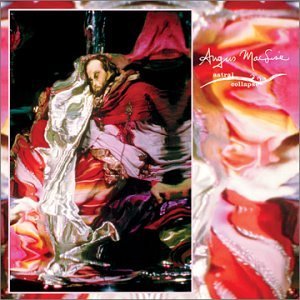
Smothered Under Astral Collapse
Angus Maclise was a composer, master percussionist, poet, mystic, calligrapher, occultist and former Velvet Underground member. His music runs the gamut of the experimental realm: drone, electronics & noise, tape cut-ups, spoken word, minimalism. Though he created a vast body of work from the 60's to 70's, it went unreleased, the master tapes sitting in a box in someone's closet. Only recently has his music been seeing the light of day via several releases on the Quakebasket label. The latest, Astral Collapse, compiles his more electronic/noise workouts:
1. Smothered Under Astral Collapse - Angus recites his Tibetan Buddhist poetry over prepared tape cut-ups. His source material for the prepared tapes is Tibetan chanting and some odd drum loops. The way he manipulates it gives it a really churning, eerie feeling.
2. 6th Face Of The Angel - Pure droning. 17+ minutes of transcendant, tape-delayed organ with little intricate change ups in oscillation and resonance.
3. Beelzebub - This is the only percussion piece on the album. The way he plays the drums and then sonically treats the mix creates a feeling musique concrete or early electronic pulse music. it's very glitchy.
4. Cloud Watching - a beautifully sinister piece. it's a murky blend of organic instruments that just twinkle and drone along in a hazy impressionistic cloud.
5. Dracula - Trial by noise. Angus rips apart the air with an ARP modular synthesizer. This kind of destruction wouldn't be heard again until Coil's Constant Shallowness Leads To Evil.
6. Dawn Chorus - several layers of prepared tapes cut up into a collage of white noise, eastern drone and field recordings from the East. Angus leads us back into more Tibetan poetry before letting us go.
You can really hear the sound that COIL would take on and expand. It foreshadows the concepts of Moon's Milk: Spring Equinox or Under an Unquiet Skull, Astral Disaster (they are eerily similar in more than just name) and Constant Shallowness Leads To Evil....to quote Jhonn Balance, Angus was a "liminal genius".
For those of you who like Throbbing Gristle, Coil, William S. Burroughs, Aleister Crowley, magick and experimental electronics, this is right up your alley.
Angus Maclise was a composer, master percussionist, poet, mystic, calligrapher, occultist and former Velvet Underground member. His music runs the gamut of the experimental realm: drone, electronics & noise, tape cut-ups, spoken word, minimalism. Though he created a vast body of work from the 60's to 70's, it went unreleased, the master tapes sitting in a box in someone's closet. Only recently has his music been seeing the light of day via several releases on the Quakebasket label. The latest, Astral Collapse, compiles his more electronic/noise workouts:
1. Smothered Under Astral Collapse - Angus recites his Tibetan Buddhist poetry over prepared tape cut-ups. His source material for the prepared tapes is Tibetan chanting and some odd drum loops. The way he manipulates it gives it a really churning, eerie feeling.
2. 6th Face Of The Angel - Pure droning. 17+ minutes of transcendant, tape-delayed organ with little intricate change ups in oscillation and resonance.
3. Beelzebub - This is the only percussion piece on the album. The way he plays the drums and then sonically treats the mix creates a feeling musique concrete or early electronic pulse music. it's very glitchy.
4. Cloud Watching - a beautifully sinister piece. it's a murky blend of organic instruments that just twinkle and drone along in a hazy impressionistic cloud.
5. Dracula - Trial by noise. Angus rips apart the air with an ARP modular synthesizer. This kind of destruction wouldn't be heard again until Coil's Constant Shallowness Leads To Evil.
6. Dawn Chorus - several layers of prepared tapes cut up into a collage of white noise, eastern drone and field recordings from the East. Angus leads us back into more Tibetan poetry before letting us go.
You can really hear the sound that COIL would take on and expand. It foreshadows the concepts of Moon's Milk: Spring Equinox or Under an Unquiet Skull, Astral Disaster (they are eerily similar in more than just name) and Constant Shallowness Leads To Evil....to quote Jhonn Balance, Angus was a "liminal genius".
~Reviewed by: Philippe Landry (2/24/05)
----------------------------------------------------------------------------------------------------
**For more info, read an earlier post focusing on the history of Drones and on the genre's creator, LaMonte Young (teacher/mentor to John Cale & Angus Maclise), and LaMonte's "The Eternal Theater", etc.
Subscribe to:
Posts (Atom)


